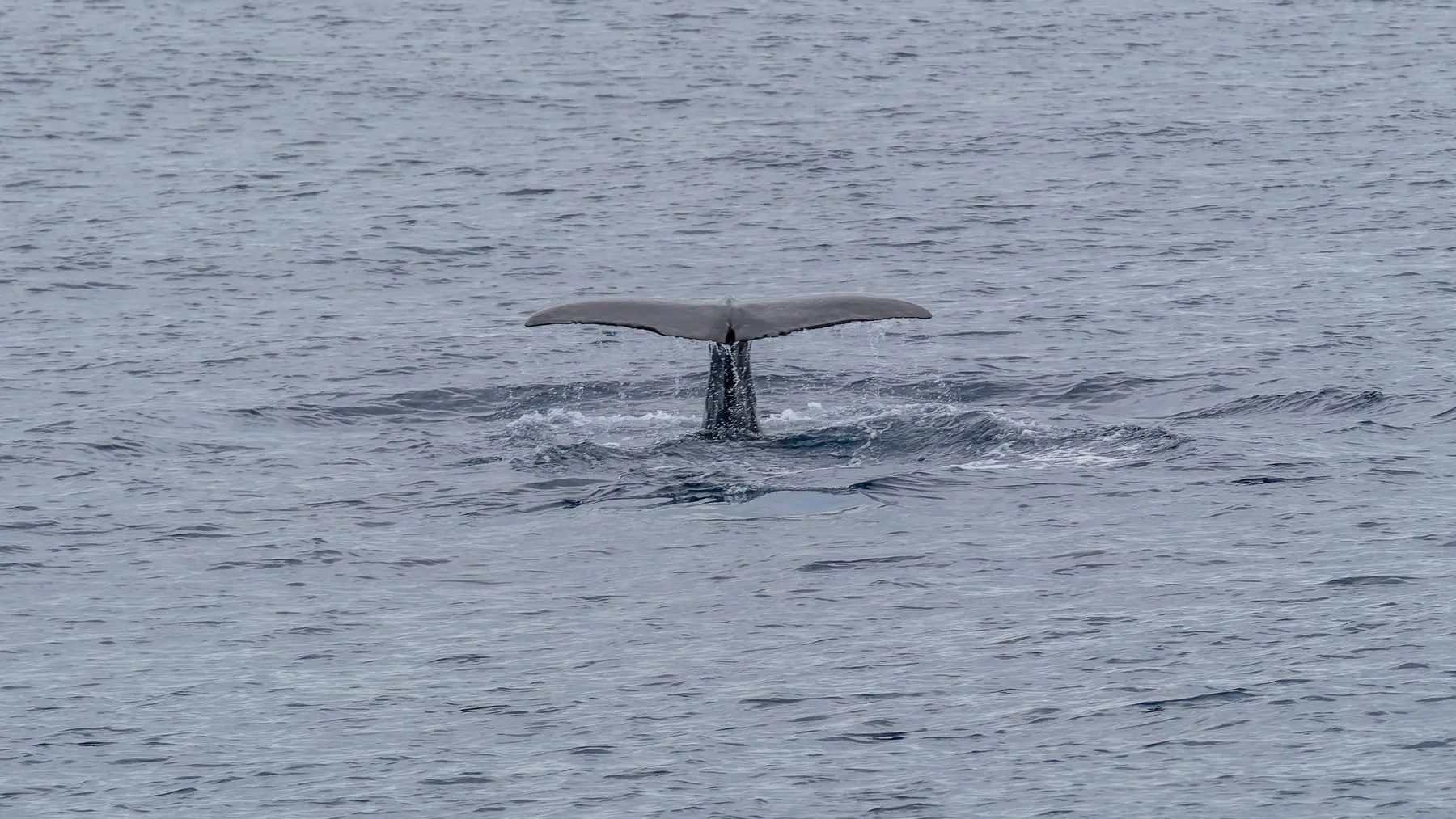
Azores whale watching is easiest from São Miguel, where 3-hour boat trips cost about €65 to €78 (about $72 to $87) per adult (prices checked October 2026). Sperm whales are seen all year, and blue, fin and sei whales peak in April and May. Our pick is the Azores whale-watching tour from Ponta Delgada with Picos de Aventura, the most-reviewed whale trip from Ponta Delgada we found on Viator.
Boats leave Ponta Delgada and Vila Franca do Campo all year, and the big migrating whales pass mainly from March to June. On the Picos de Aventura trip you choose a catamaran or a speedboat when you book, and marine biologists brief you before departure.
Azores whale-watching tours compared
Three companies run most São Miguel trips that you can book online. They all use land-based lookouts to find the animals and carry a marine biologist or trained guide, which the Azores licensing rules require. Prices are each operator’s own adult rates, checked October 2026, with dollars at €1 = $1.11.
| Tour | Departs from | Boat | Length | Adult price | Best for |
|---|---|---|---|---|---|
| Picos de Aventura whale-watching tour (our pick) | Ponta Delgada marina | Catamaran or speedboat | About 3 hours | About €65 ($72) on booking sites | Most travelers, especially if you’re staying in Ponta Delgada |
| Futurismo whale and dolphin trip | Portas do Mar, Ponta Delgada | Catamaran or zodiac | About 3 hours | €70 + €4.20 online fee ($78 + $5) | Families who want the catamaran, and the free second trip if nothing is seen |
| Terra Azul whale watching and islet tour | Vila Franca do Campo marina | Zodiac | About 3 hours | €65 Oct-Mar, €78 Apr-Sep ($72 / $87) | Small groups, a loop around the Vila Franca islet, staying east of Ponta Delgada |
| Swim with wild dolphins (Picos de Aventura) | Ponta Delgada marina | Small boat | Half day | Roughly double a whale trip | Confident swimmers who want to get in the water |
Children pay less on every trip. Futurismo charges half price for ages 6 to 12 and nothing for under-6s, who can only ride the catamaran. Terra Azul charges €45 (about $50) for children from October to March and €54 (about $60) from April to September, and doesn’t take children under 4.
Which whale-watching tour should you book?
- Best overall: the Picos de Aventura whale-watching tour leaves from the marina in central Ponta Delgada and lets you pick the stable catamaran or the faster speedboat when you book.
- Best for families with young kids: the Futurismo trip on GetYourGuide runs a catamaran with a restroom on board, which Futurismo recommends for babies, young children and visitors with back problems.
- Best small-boat trip: the Terra Azul zodiac trip from Vila Franca do Campo adds a short loop around the Vila Franca islet, a flooded volcanic crater offshore, at no extra cost.
- If your dates are sold out: compare all whale-watching trips from Ponta Delgada on Viator, where smaller operators and private charters sometimes still have seats.
When is the best time for whale watching in the Azores?
April and May are the best months for the widest range of big whales, and any month works for sperm whales and dolphins. The clearest numbers come from a study of whale-watching data collected on Futurismo’s boats off São Miguel’s south coast from 2006 to 2013, presented at the International Meeting on Marine Research in 2014 (González et al.):
- Baleen whales are a spring event. Of 491 baleen whale sightings, 81.7% came between March and June. Fin whales were the most common (221 sightings), then sei whales (143) and blue whales (83).
- Blue whales cluster in March to May. May had 32 blue whale sightings, April 24 and March 20, together 91.6% of all blue whale records.
- Humpbacks and minke whales are rare bonuses, with 15 and 16 sightings in eight years.
- Bryde’s whales were the summer exception, seen only in late July and August.
Sperm whales live around the islands all year, and common, bottlenose and Risso’s dolphins are regulars. Over the eight years, the study logged 7,691 sightings of 20 cetacean species.
| When you travel | What you’re likely to see | Trade-off |
|---|---|---|
| March to June | Sperm whales plus migrating blue, fin and sei whales; April and May are the peak | The most sought-after weeks: book as soon as your dates are set |
| July to September | Sperm whales and dolphins, the occasional Bryde’s whale | Busiest season overall, and usually the calmest seas |
| October to February | Sperm whales and dolphins | Trips depend more on the weather, and there are fewer departures a day |
Book the boat trip for the first or second day of your stay. If the sea is too rough, operators move you to another date, and a spare day gives you room for that. Our 4-day São Miguel itinerary puts whale watching on day two for this reason.
Catamaran or zodiac: which boat should you choose?
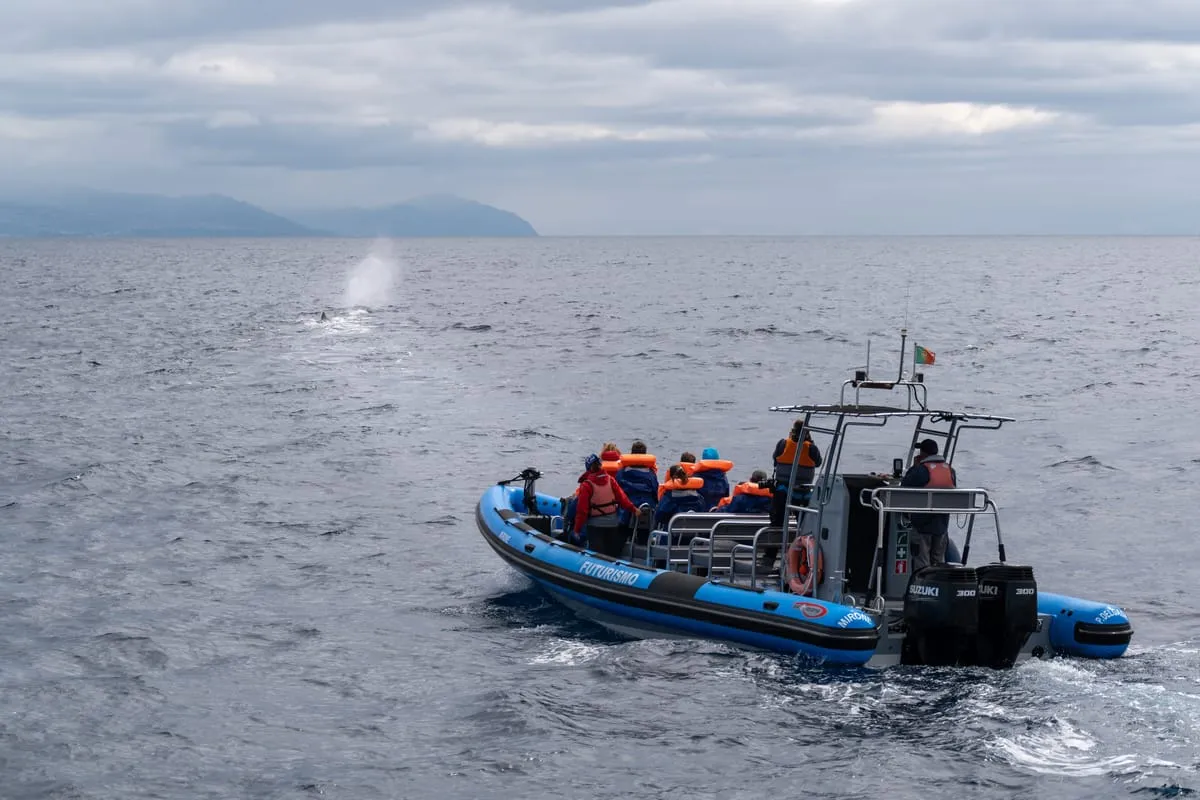
Pick the catamaran if anyone in your group is under 6, gets seasick or has back trouble; pick the zodiac if you want speed and a view at water level. Both go to the same areas, guided by the same lookouts.
| Catamaran | Zodiac (rigid inflatable) | |
|---|---|---|
| Ride | Larger and more stable | Fast, bumpy and splashy |
| Restroom | Yes, on Futurismo’s catamaran | No |
| Minimum age | None at Futurismo (babies welcome) | Usually 6 |
| View | Raised deck, good for photos | Close to the water |
| What to wear | Layers | Operators lend raincoats and pants on zodiacs |
| Who it suits | Families, seniors, anyone with back problems | Adults and older kids who want adventure |
Futurismo notes that nothing is sold on board, so take seasickness tablets before you leave the marina if you need them, and bring water and a snack. Futurismo steers anyone with back problems to the catamaran, and booking sites list the speedboat trips as unsuitable during pregnancy, so check with the operator first. If you’re unsure, book the catamaran option: both Ponta Delgada operators run one.
How Azores whale watching works
Whale watching in the Azores grew out of the islands’ whaling past, and the old system of shore lookouts still runs the show. A spotter called a vigia sits on a cliff with binoculars and radios the boats when they spot a blow, so trips head straight for the animals instead of searching blind.
The Azores tourism authority licenses every commercial operator, and each license requires:
- A specialist with a degree in marine biology or animal behavior who advises on how to approach the animals and records sightings.
- A crew trained in how to behave around cetaceans.
- An onboard guide and a lookout to find the animals.
- Boats no longer than 20 meters (66 feet) around São Miguel.
On the water, operators work to a code of conduct. Futurismo’s published rules keep boats at least 50 meters (164 feet) from the animals and 100 meters (328 feet) from mothers with calves, allow no more than three boats near the same group, and limit each boat’s time with whales to 15 minutes. Expect the boat to stop, idle and wait rather than chase.
A typical trip looks like this: check in at the marina about 30 minutes before departure, a safety briefing and a talk from the biologist, then 2 to 3 hours at sea, longer if the lookouts send the boat far offshore.
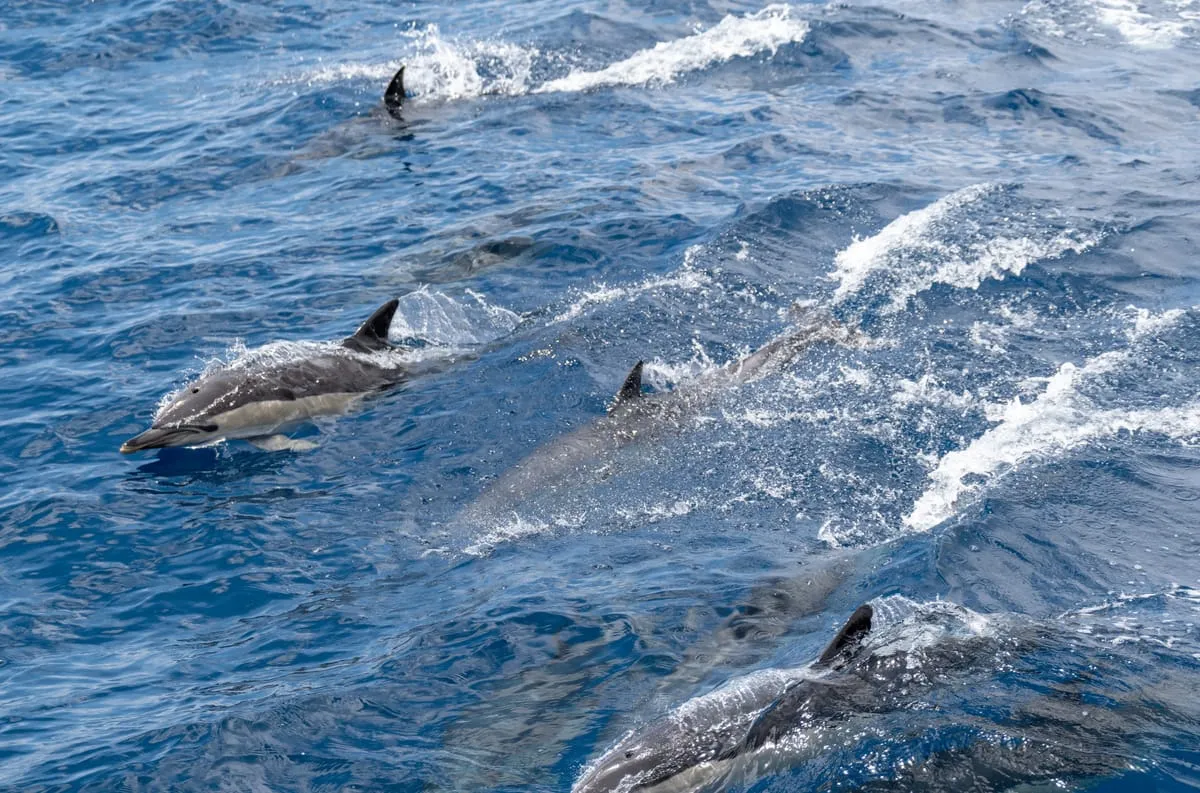
What if you don’t see any whales?
Most trips see whales or dolphins, but no operator can promise wild animals, and the guarantees differ by company:
- Futurismo says that if no cetaceans are seen, you can join another departure for free, and it advertises sighting rates of 98% to 99%.
- Terra Azul offers a free second tour within 30 days, or an 80% refund if you can’t rebook. That guarantee applies only to tours booked on its own website, so through GetYourGuide you rely on the listing’s cancellation terms instead.
- Weather cancellations: Futurismo and Terra Azul both offer a new date or a full refund when the sea is unsafe.
The practical answer is to book early in your stay and choose a trip with flexible cancellation. The Picos de Aventura tour offered a full refund up to 24 hours before departure when we checked, so you can lock in a date before your flights are final.
Can you swim with whales or dolphins in the Azores?
You can swim with wild dolphins, but not with whales: the Azores tourism authority states plainly that swimming with whales is forbidden. Dolphin swims are their own trip, with a briefing before you go and swimmers taking turns in the water in small numbers.
- From Ponta Delgada: swim with wild dolphins with Picos de Aventura, a half-day trip from the city marina.
- From Vila Franca do Campo: the Terra Azul dolphin swim and snorkel trip. Terra Azul’s own rate is €116 (about $129) per adult for its October to mid-April season, with 3-7 mm wetsuits, hoods, gloves and socks included, and two swimmers in the water at a time.
You need to be a confident swimmer, and the operators say contact can’t be guaranteed: dolphins choose whether to stay. Common, bottlenose, striped and Risso’s dolphins are the species you’re most likely to meet.
Ponta Delgada or Vila Franca do Campo?
Base your choice on where you sleep. Ponta Delgada’s marina is in the city center, so if you’re staying there, the Picos de Aventura and Futurismo trips need no car. Hotels within walking distance of the marina include the modern Octant Ponta Delgada and the classic Grand Hotel Açores Atlântico.
Vila Franca do Campo is further east along the south coast. Terra Azul runs its trips from the marina there, with departures at 8:30 am and 12:30 pm all year and 3:40 pm from April to October. It’s a good fit if you’re staying near Furnas or driving the east of the island anyway. You’ll need a car for that; compare Hertz rental cars at Ponta Delgada airport, which also makes the crater lakes and the São Miguel hot springs easy to reach.
What about Pico and Faial?
Pico and Faial, in the central Azores, are the islands’ other whale-watching hub, with trips from Lajes do Pico and Horta. They’re a good add-on for a longer trip, but the nonstop flights from the US land on São Miguel, so it’s the simplest place for a first whale-watching trip.
What to bring and practical tips
- Layers and a windproof jacket, even in August. It’s always cooler at sea.
- Sunscreen and sunglasses. You’re on open water for up to three hours.
- A phone or camera with a zoom and a strap. Whales surface for minutes at a time, then dive.
- Seasickness tablets, taken before you board.
- Mobile data. Operators message about weather changes and new departure times, often on the day. An Airalo eSIM for Portugal covers the Azores; use code GUIDEZ15 at checkout if you’re new to Airalo, or GUIDEZ10 if you’ve bought from them before. Verizon’s TravelPass costs $12 a day per line, and our Airalo vs local SIM vs roaming comparison runs the numbers.
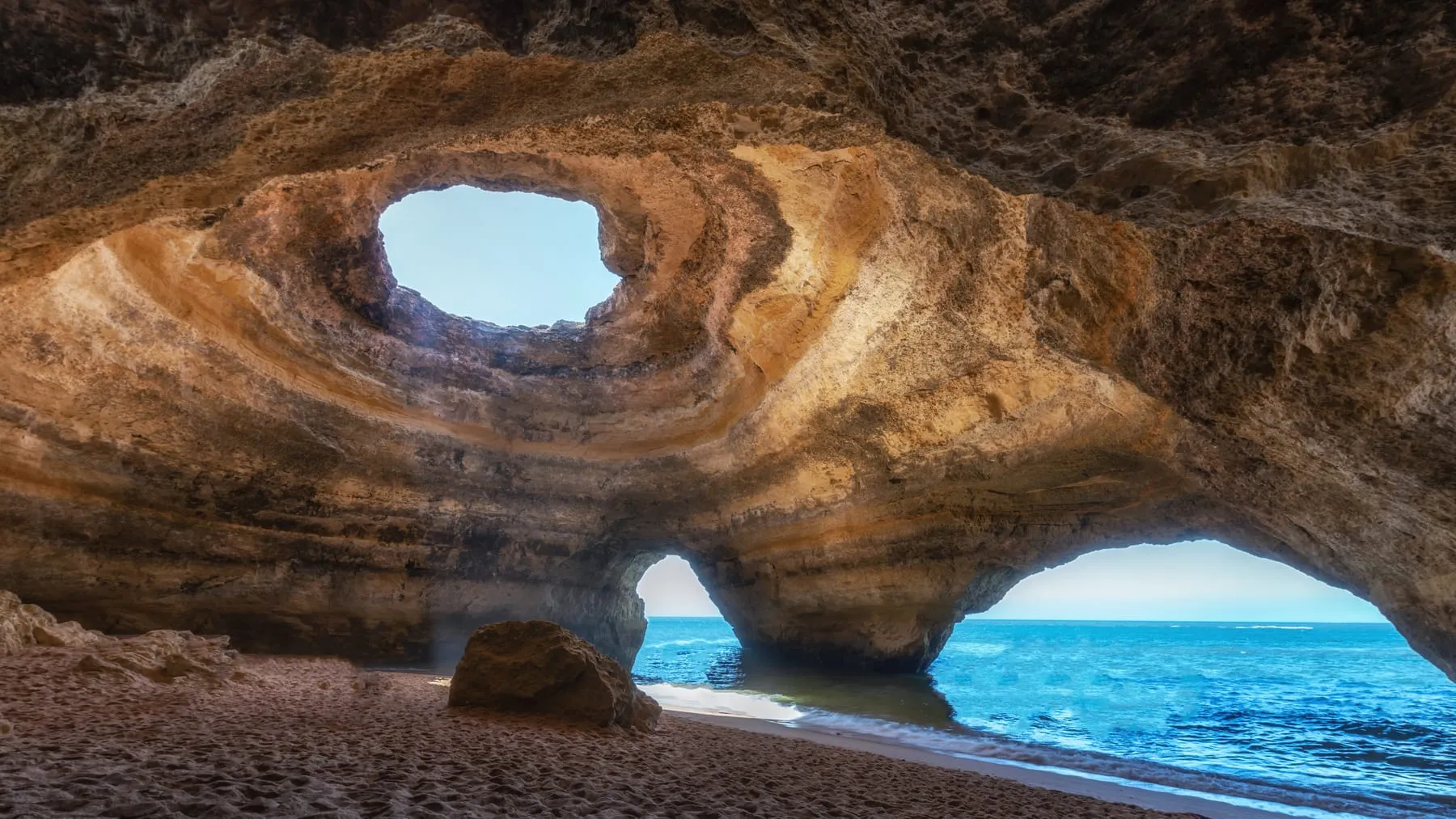
Getting there from the US: Azores Airlines flies nonstop from Boston to Ponta Delgada in about 5 hours, and most other US cities connect through Boston or Lisbon. If you’re combining the Azores with the mainland, our 3-day Lisbon itinerary covers the capital, and our Benagil cave tours comparison covers the best boat trip on the Algarve coast.
Ready to book? Reserve the Picos de Aventura whale-watching tour from Ponta Delgada for the start of your stay, then plan the rest of the island with our São Miguel itinerary and finish a day at sea in Furnas with our guide to the best hot springs on São Miguel. For cafés and viewpoints between boat trips, open Traveliri’s São Miguel map on Guidez, which is in Hebrew.