Getting from Budapest airport to the city center takes about 40 minutes and 2,500 Ft (about $8) on the 100E Airport Express bus, which runs around the clock to Deák Ferenc tér, or roughly 30 minutes and about 14,000 Ft (about $42) by taxi (prices checked October 2026). After an overnight flight from the US, our pick is a private arrival transfer from Budapest airport to your hotel.
The cheapest route is bus 200E plus metro M3: 50 to 60 minutes for about 1,000 Ft (about $3). Book the transfer before you fly: the driver meets you in arrivals, the price is fixed, and you skip the bus-stop walk with luggage at the other end.
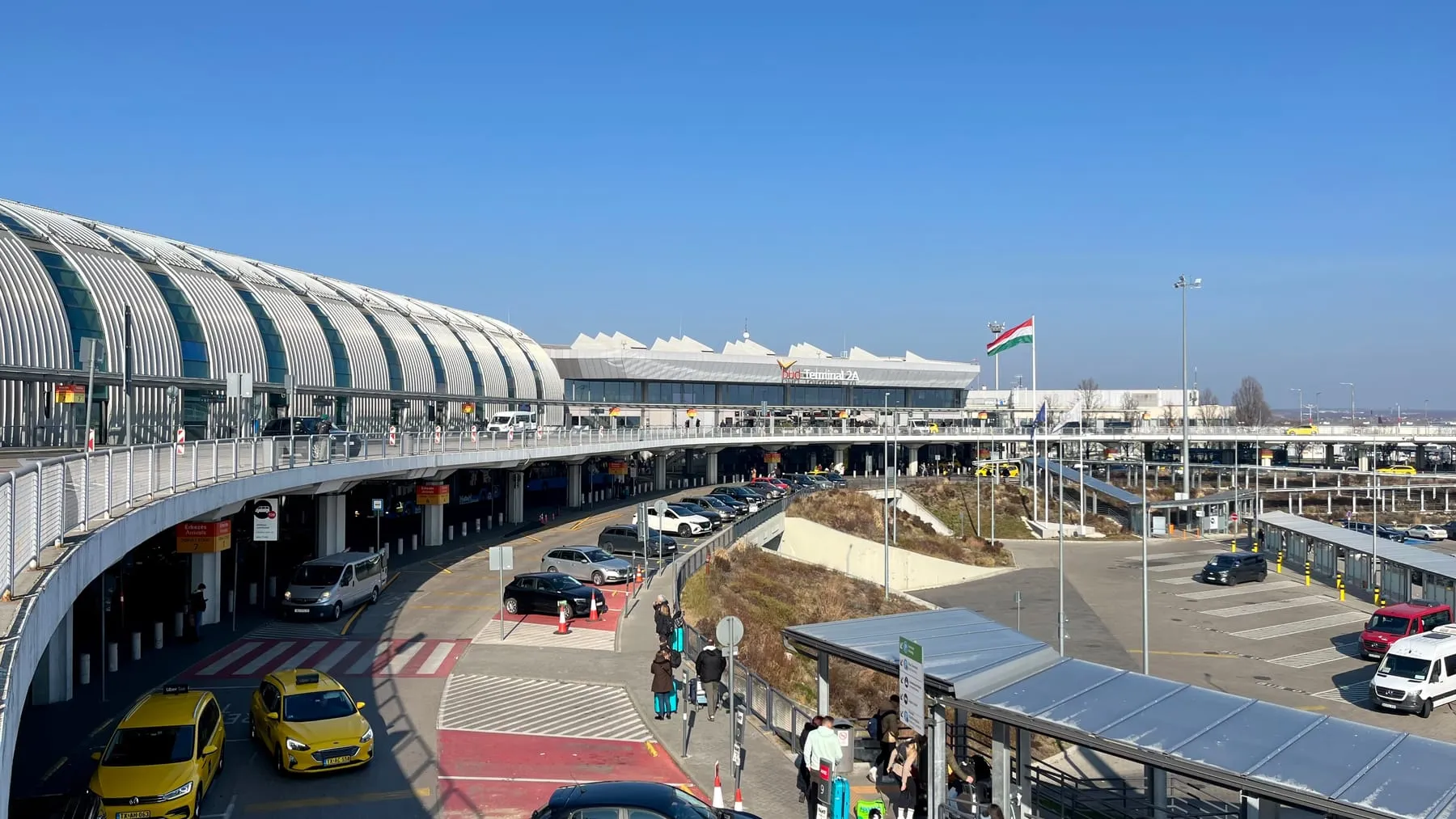
Budapest Liszt Ferenc International Airport (BUD) sits about 10 miles (16 km) southeast of the center, and passenger flights use Terminal 2, split into 2A and 2B. There is no train to the terminal, so every route in is by road. Prices below are in Hungarian forint (Ft, also written HUF), with dollars at 1,000 Ft = about $3.03, the ECB rate in late October 2026.
Budapest airport to city center: options compared
| Option | Price (Oct 2026) | Time to the center | Where it drops you | Best for |
|---|---|---|---|---|
| Private transfer | From €27 (about $30) on Viator; final price depends on group size | Roughly 30 min, longer in traffic | Your hotel door | Families, groups, late arrivals, first-timers |
| Shared shuttle | Around $20 per person | 30 to 40 min, plus other passengers’ stops | Your hotel or address | Solo travelers who want door-to-door |
| 100E Airport Express bus | 2,500 Ft (about $8) | About 40 min | Kálvin tér and Deák Ferenc tér (Astoria at certain night hours) | Solo travelers and couples with light bags |
| Bus 200E + metro M3 | About 1,000 Ft (about $3) on two tickets | 50 to 60 min | Any M3 station, including Deák Ferenc tér | The lowest fare, hotels on the M3 line |
| Taxi (Főtaxi or Uber) | About 14,000 Ft (about $42) per car | Roughly 30 min, longer in traffic | Your hotel door | Arrivals without a booking |
Deák Ferenc tér, where the 100E ends, is the city’s main transit hub in central Pest, where three metro lines meet. From there most hotels in the Inner City, the Jewish Quarter and along Andrássy Avenue are a short walk or one metro stop away. Buda-side hotels near the Castle District need another tram, bus or taxi ride.
Which should you book?
Decide by group size, bags and arrival time:
- Solo, light bags, daytime arrival: take the 100E. It’s the best value for one person and drops you in the center in about 40 minutes.
- Two people: the 100E costs 5,000 Ft (about $15) for the pair, a third of a taxi. If your hotel is more than a short walk from a 100E stop, or you land tired after a red-eye, a private transfer to your hotel is worth the difference.
- Three or more, kids or big suitcases: book a private transfer. Four 100E tickets cost 10,000 Ft (about $30), and you’d still haul the bags from Deák Ferenc tér. A car to the door costs about the same as a taxi, with the price settled in advance.
- Landing late at night: the 100E still runs, but less often. A pre-booked driver who tracks your flight saves a long wait after a delayed landing.
- Lowest possible fare: bus 200E plus metro M3, if your hotel is near an M3 station.
Whatever you choose, get your phone online before you land. Maps, BudapestGO tickets and your transfer driver’s messages all need data. A Hungary eSIM from Airalo is installed before you fly and works the moment you switch off airplane mode; use code GUIDEZ15 at checkout if you’re new to Airalo, or GUIDEZ10 if you’ve bought from them before.
How the 100E Airport Express works
The 100E is the direct express bus between the airport and downtown Pest, run for the city transit authority BKK. It leaves from the Liszt Ferenc Airport 2 stop outside the Terminal 2 arrivals area, so follow the bus signs once you’re through customs.
Price: a one-way ticket costs 2,500 Ft (about $8). The Budapest Assembly approved the rise from 2,200 Ft in 2025, Economx reported. The 100E needs its own ticket: regular Budapest single tickets and day passes aren’t valid on it, and a 100E ticket isn’t valid on bus 200E, according to Budapest Airport’s bus page. If you already hold a monthly or other Budapest pass, BKK sells a 1,000 Ft (about $3) add-on 100E ticket in the BudapestGO app; the 15-day pass is excluded.
Where to buy: in the BudapestGO app, from BKK ticket machines and the BKK customer service point at the airport, or by tapping a contactless bank card on the validator when you board. US Visa and Mastercard cards work; pick one with no foreign transaction fee. Validate a paper or app ticket as soon as you get on.
Stops: from the airport the bus runs nonstop along Üllői út to Kálvin tér, then Deák Ferenc tér. Astoria, between the two, is served only at certain hours of the night.
Frequency and hours: the 100E runs 24 hours a day, every day. Since April 1, 2026, buses leave every 5 to 6 minutes during the day, according to Economx. In the small hours, expect a bus roughly every 30 to 40 minutes.
Journey time: about 40 minutes, longer in rush-hour traffic on Üllői út.
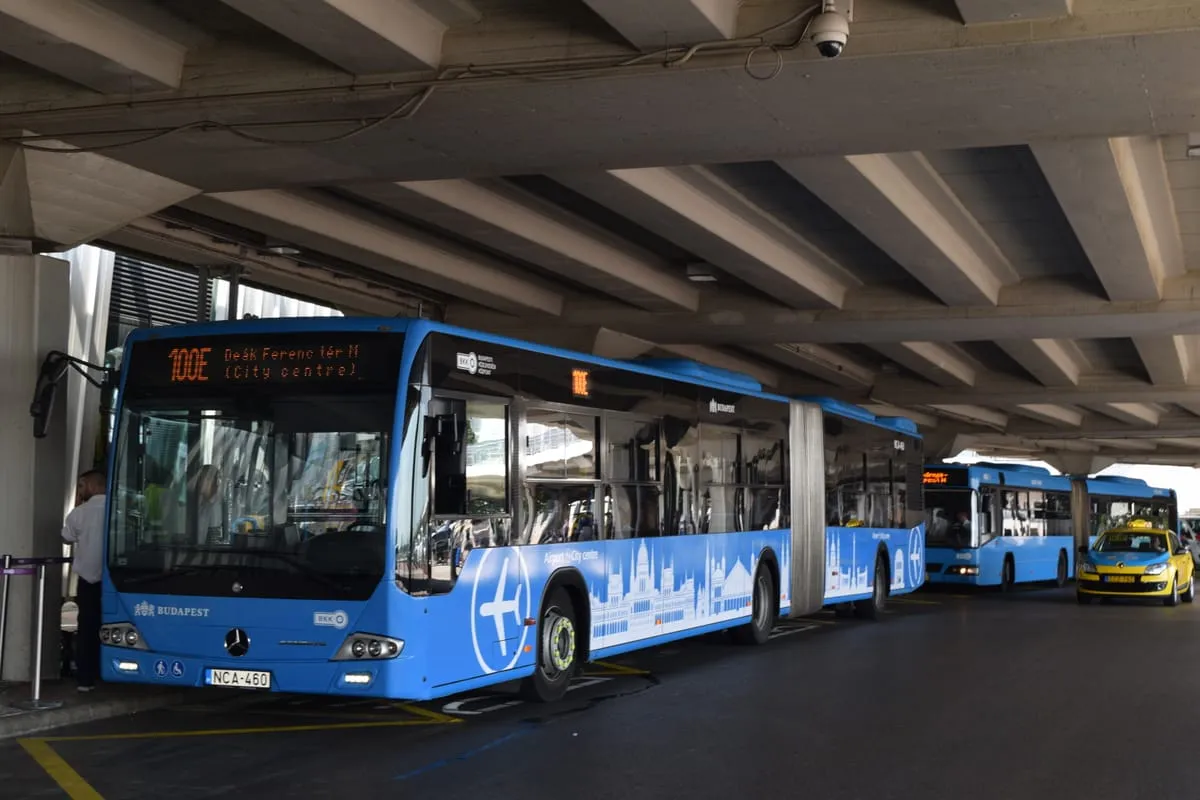
Budapest Card holders can ride the 100E for free: BKK says the 72-hour PLUS and FLEXI versions include one free ride in each direction. If you were already planning to buy one for museums and transit, it covers the airport run too.
The cheapest way: bus 200E and metro M3
The 200E is an ordinary BKK bus from Terminal 2 to Kőbánya-Kispest, the southern end of metro line M3, with a stop at Ferihegy railway station on the way. Regular BKK tickets and passes are valid on it.
- Catch the 200E outside Terminal 2 arrivals. The ride to Kőbánya-Kispest takes about 20 to 25 minutes.
- Change to metro M3 at Kőbánya-Kispest, heading toward Újpest-központ.
- Ride M3 to Deák Ferenc tér (about 16 to 20 minutes) or to the stop nearest your hotel.
A single ticket costs 500 Ft (about $1.50) and covers one ride, so the bus and the metro take two: about 1,000 Ft (about $3) in all. A Budapest 24-hour or 72-hour travelcard covers both legs if you’re buying one anyway. Allow 50 to 60 minutes door to door.
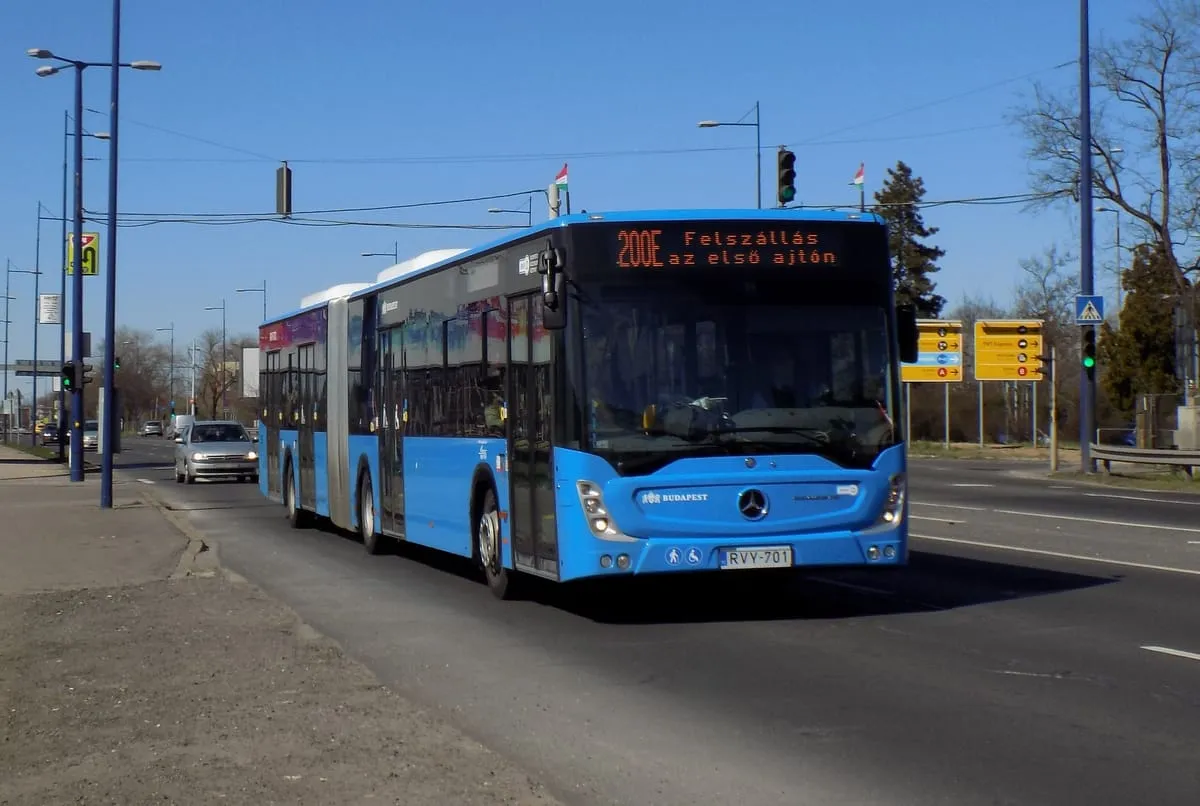
The catch is the change with luggage, plus the walk from your M3 station. Late at night some 200E trips run to Határ út instead of Kőbánya-Kispest, so after about 11 pm the 100E is the simpler public option.
How much is a taxi from Budapest airport?
A taxi from Budapest airport to central Pest costs about 14,000 Ft (about $42) after the August 2026 fare increase, by BudAPPest’s estimate. Budapest taxi fares are regulated by the city, and from August 1, 2026 they are:
| Charge | Regulated rate since August 1, 2026 |
|---|---|
| Base fare | 1,300 Ft (about $4) |
| Airport surcharge | 800 Ft, so an airport trip starts at 2,100 Ft |
| Per kilometer | 521 Ft (about $1.60) |
| Per minute of waiting | 130 Ft |
Those rates come from Xpatloop’s report on the new tariff. Taxis are metered, so heavy traffic or a hotel on the far side of Buda pushes the fare up.
Where to find one: Főtaxi, the yellow cabs, is the airport’s official taxi partner and the only company with a rank at the terminal curb, outside Terminals 2A and 2B. Uber also operates at the airport through its licensed Hungarian partner; check the pickup point in the app, because other app and company cars use a car park farther from the doors. Bank cards are accepted.
A taxi is a fine choice when you arrive without a plan. If you know your flight, a pre-booked private transfer (below) costs about the same, and the price doesn’t climb in a traffic jam.
Private and shared airport transfers
A pre-booked transfer is the easiest way in when you have bags, kids or a late landing. We compared the options on Viator and GetYourGuide in October 2026:
- Best overall: the Budapest one-way private airport transfer. It’s the most-reviewed of the Budapest airport transfers we checked on Viator, with a driver waiting in arrivals and a car to any central hotel. It runs in both directions, so you can also book it for your departure.
- Best alternative: Budapest Airport Transfers, another highly rated private service with arrival and departure options. Compare the two for your group size and date.
- Best for round trips: the private roundtrip airport transfer books your arrival and your ride back to the airport in one go, so the last morning of your trip is sorted too.
- Best for solo travelers: the shared airport shuttle on GetYourGuide. Minibuses run around the clock and drop you at your hotel, with one large suitcase and one carry-on per person included. You share the ride, so expect a stop or two before yours.
Viator transfers generally offer free cancellation up to 24 hours before pickup; check the terms on the listing before you pay. Give the exact hotel address and your flight number when you book, so the driver can track delays.
Arriving in Budapest from the US
Flights: American Airlines started a seasonal nonstop from Philadelphia to Budapest on May 21, 2026, the only US nonstop we found, according to American’s newsroom. Outside summer, you’ll connect through a European hub such as Frankfurt, Munich, Amsterdam, Paris, London or Istanbul.
Passport control: flying in from outside the Schengen area, you clear passport control in Budapest; connecting through a Schengen hub such as Frankfurt or Paris, you clear it there instead. US passport holders don’t need a visa for stays of up to 90 days. ETIAS, the EU’s travel authorization for visa-free visitors, hadn’t started when we checked in October 2026, and the EU Delegation to the US says the start date will be announced ahead of time.
Money: Hungary uses the forint, not the euro. Cards work almost everywhere in Budapest, including taxis and the 100E. If you need cash, use a bank ATM and decline the machine’s offer to convert to dollars.
Phone: US carriers’ international day passes add up over a long trip: Verizon’s TravelPass costs $12 a day per line. A Hungary eSIM from Airalo is a one-time purchase instead of a daily fee (codes GUIDEZ15 for new customers, GUIDEZ10 for returning ones), and our Airalo vs local SIM vs roaming comparison runs the numbers. If you log in to your bank or a booking site on airport or hotel Wi-Fi, a VPN such as Surfshark encrypts what you send over the shared network. Unsure? Our guide covers whether you need a travel VPN at all.
Flying into Vienna instead?
Some trips start in Vienna, which has more transatlantic flights. Vienna to Budapest takes about 2 hours 40 minutes by direct train, with departures roughly every hour, according to the Man in Seat 61. You can compare Vienna to Budapest trains on Omio and book the cheapest advance fare. Our Prague, Vienna and Budapest itinerary shows how to fit all three cities into 7 to 10 days.
Your first evening in Budapest
Once your bags are at the hotel, the river is the easy first outing. A one-hour Danube night cruise with a drink passes the floodlit Parliament and Buda Castle, and it’s sitting down, which suits jet lag. The Parliament is worth a daytime visit too, and its tours sell out in season: our guide to Hungarian Parliament tour tickets explains how to get a slot. Our Budapest Danube river cruises guide compares night, day and dinner cruises. To plan the rest of your stay, our 3 days in Budapest itinerary has a day-by-day plan with prices. On day two, a soak at Széchenyi or Rudas is the classic cure for a long flight: see our Budapest thermal baths compared for prices and which bath to pick.
If you’d rather land and be driven straight to the door, book the private Budapest airport transfer now and you’re done. For places to eat, drink and stay once you’re in town, open Maya Barkan’s Budapest map on Guidez, which is in Hebrew.